WASHINGTON COUNTY HISTORICAL SOCIETY (Washington County, Utah)
WOODWARD SCHOOL
St. George, Utah
LOCATION
15 South 100 WestSt. George, Utah
Telephone 130 in the 1941 telephone book (Woodward High School)
Telephone 130 in the 1954 telephone book (Woodward High School)
Telephone ORchard 3-2312 in the 1958 telephone book (Woodward Senior High)
Telephone ORchard 3-2722 in the 1958 telephone book (Woodward Senior High Guidance Counselor)
Telephone ORchard 3-2312 in the 1961 telephone book (Woodward Senior High)
Telephone ORchard 3-2722 in the 1961 telephone book (Woodward Senior High Guidance Counselor)
Telephone 673-2312 in the 1972 telephone book (Woodward Junior High)
Telephone 673-2722 in the 1972 telephone book (Woodward Junior High Guidance Counselor)
75 W. Tabernacle
St. George, UT 84770
Southeast corner of Tabernacle and 100 West
37° 6' 28" North Latitude, 113° 35' 2" West Longitude
2,735 feet MSL
Plat A, Block 16, Lot 5 on the old pioneer map of St. George.
DESCRIPTION
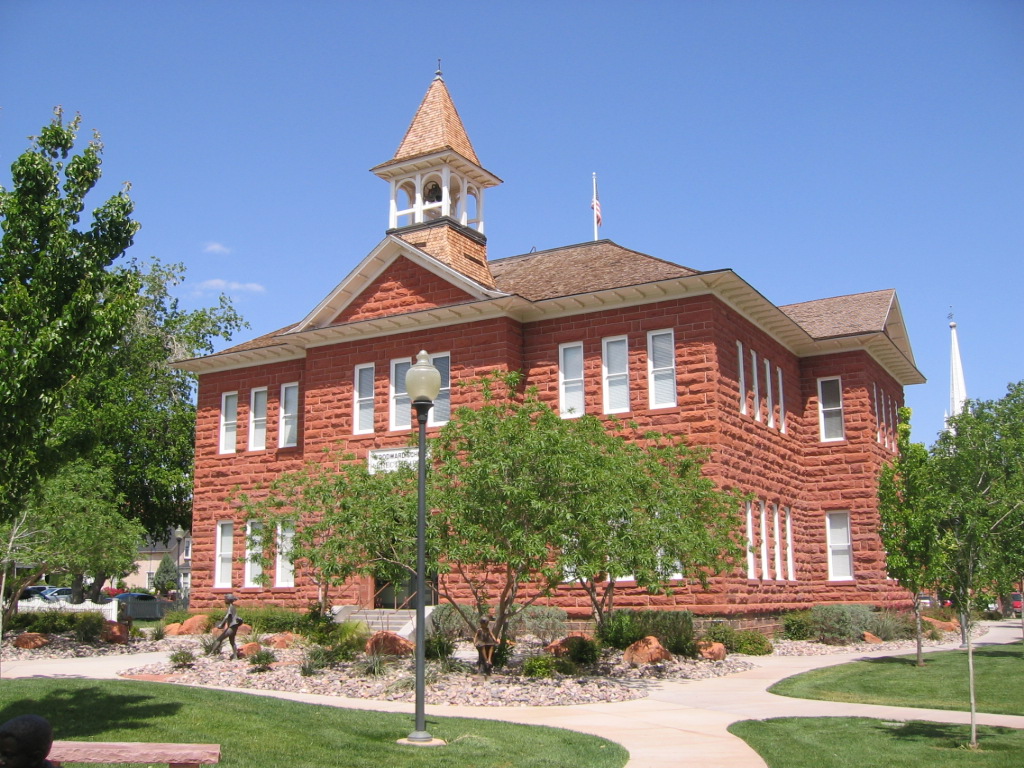
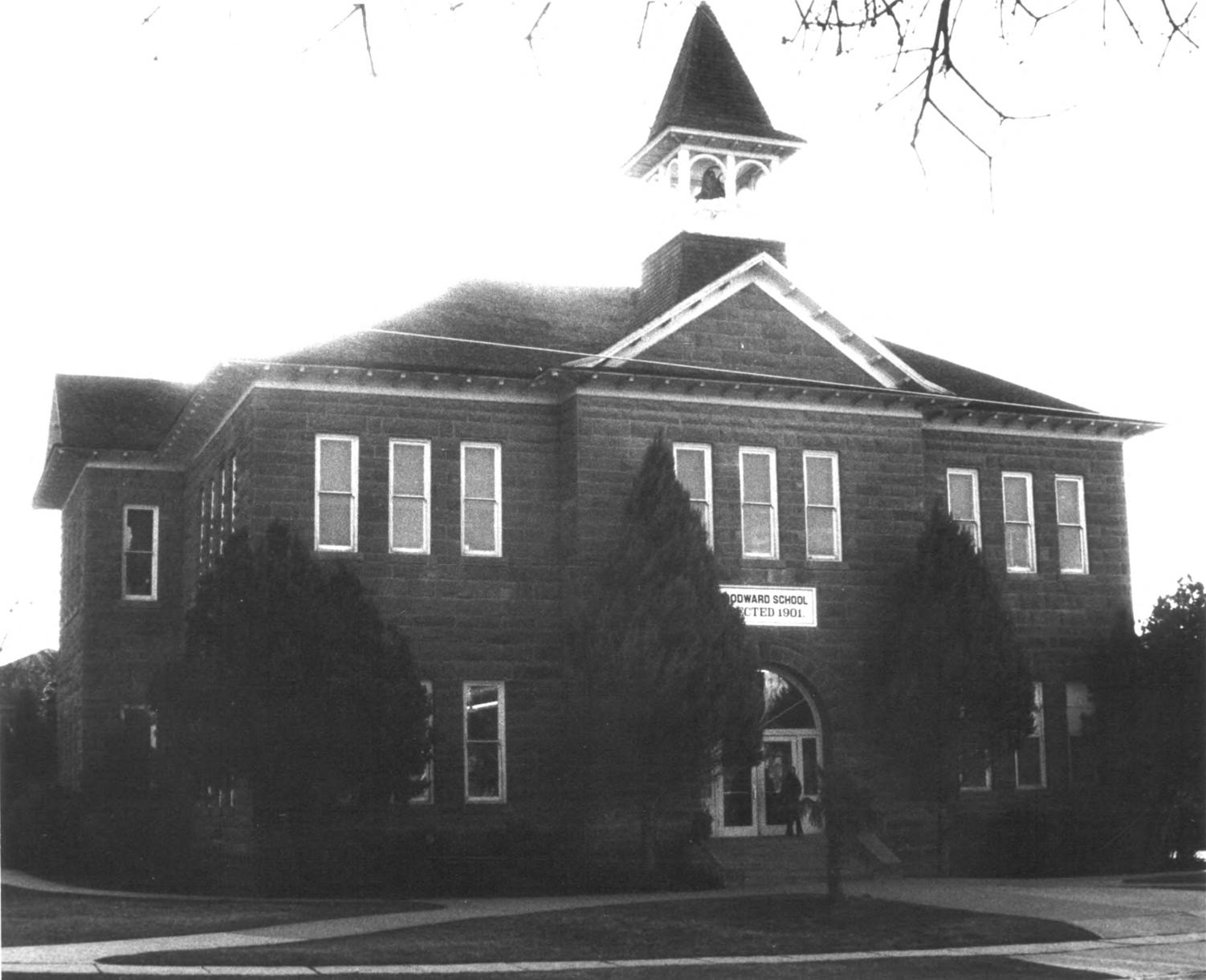
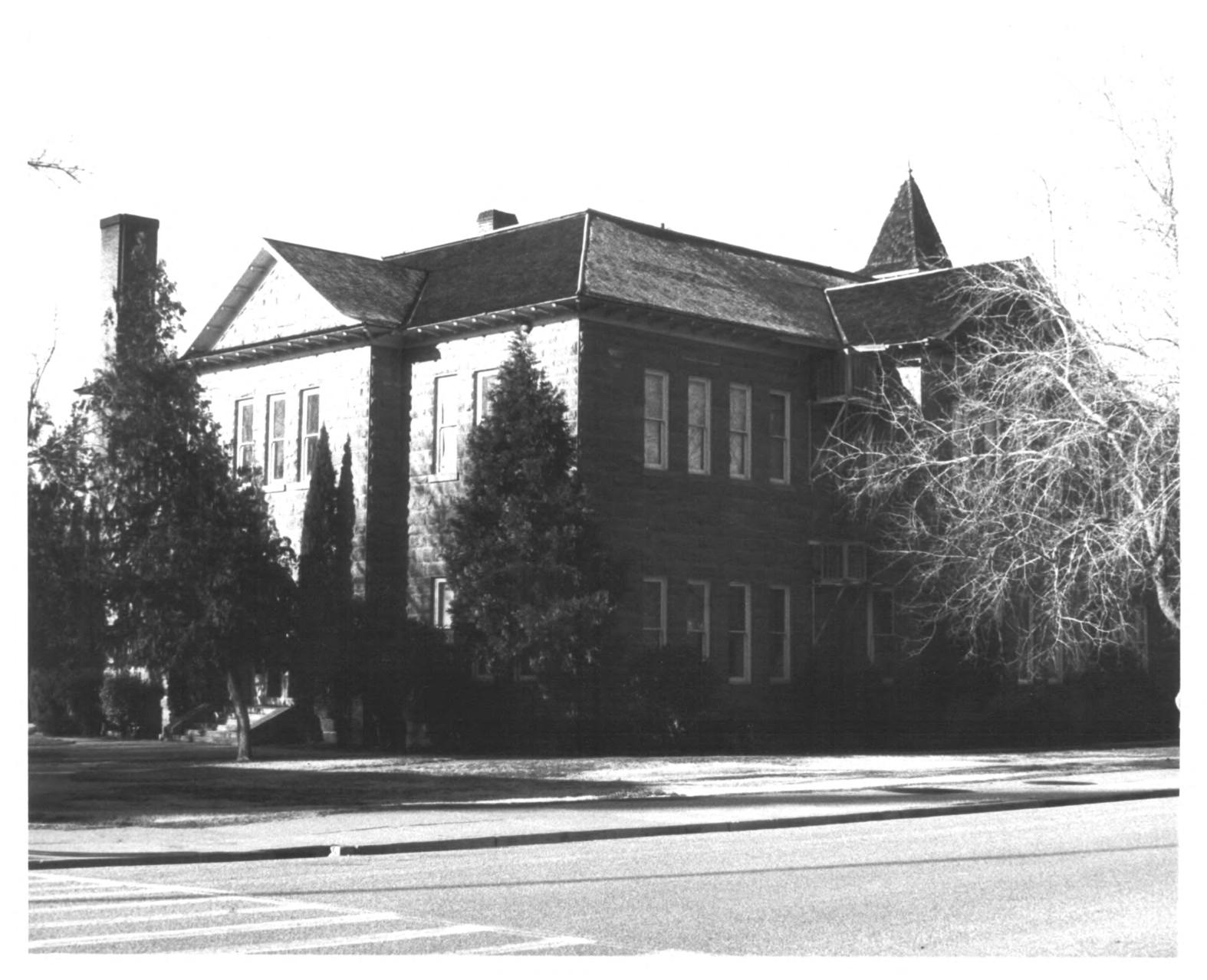
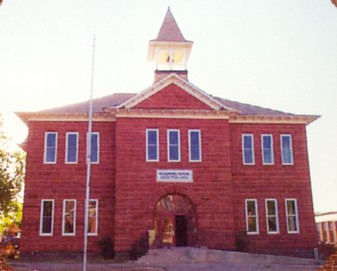
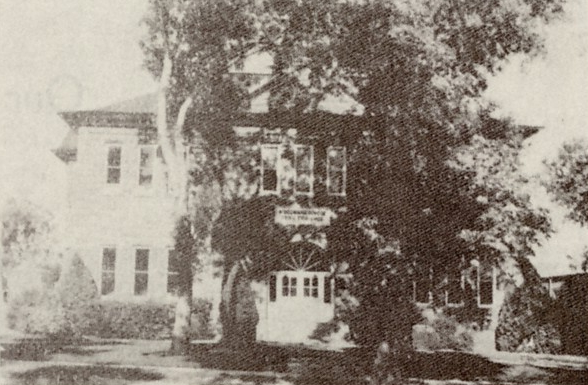
Woodward Elementary School is a two-story structure built of locally quarried stone. Volcanic stone for the foundation had been intended for an the earlier Academy building which was never built. The walls are rough-faced, regular coursed red sandstone. Following a scheme similar to that of the Washington Elementary school and the Old Dixie College building which is located at the opposite corner of the Tabernacle Block, it is characteristic of many school buildings of the period. From the rectangular, truncated hip roofed central mass, gabled bays project on each elevation forming a symmetrical configuration. Atop the main entrance pavilion is a hipped roof bell tower or cupola. Under the wide eaves are decorative brackets. Entrances on the east and west elevations are round arched.Windows are double hung sash types arranged in groups of three and four. Lintels are rough-faced blocks, coursed in conjunction with the walls. Sills are fully dressed ashlar elements which break the coursing somewhat.
Like the Old Dixie College building the Woodward School seems heavily influenced by late Victorian forms, but especially by the Richardsonian Romanesque style in the handling of materials, simplicity of form, window treatment and minimum detail. The rough-faced masonry and round arched entries are of course the primary indicator of this parallel.
HISTORY
During the 1870 and 1880s, overflow from the regular schools spilled into buildings such as the basement of the Tabernacle (three rooms), the upper floor in the old courthouse, the Gardener's Club, the building on First North built by J. W. Nixon for his tin shop, and others. By the 1890s, it became clear that something had to be done to expand the schools.In 1888, the St. George Stake established an academy that met in the basement of the Tabernacle. Plans were made for building a proper school building in the northwest corner of the Tabernacle block and a quantity of volcanic stone was actually quarried for the foundation. The building campaign stalled in 1890, however, and in 1893 the academy closed.
The provision of free public schools supported by a county tax, passed by the state legislature in 1890, had led both teachers and cash-starved parents to desert the Stake Academy. But the broader financial base afforded by the possibility of a mill levy opened new possibilities for a public school. In April of 1897, meetings were held to decide what to do. It was decided that a new central school building would be constructed on the northwest corner of the public square. In 1898, the citizens approved a twenty mill levy (2% tax, the maximum allowed by law) to finance a brick school building. Stone was ultimately chosen for its permanence, however, and obtained from the same quarry that had supplied the building of the Tabernacle. The volcanic stone cut for the unbuilt Academy was used for the foundation.
The city granted the site and construction began in 1898. By the end of the year, $7,000 had been spent putting in the foundation. They found the ground had to be tamped and filled with small lava rock to provide a suitable foundation for such a large building. The foundation was built with the black volcanic rock that had been cut some years before, when plans were laid for the construction of of a stake academy. Each year, a new tax was levied and the work slowly went forward.
The Woodward School was finished and opened its doors in September of 1901. It was named after George Woodward, a childless resident, who had served as chairman of the school board during the construction. He also donated a substantial sum of money ($3,000) for the hardware and glass. Then he bought the heating plant and the school's first piano.
The school was a real change from the previous schools. There was a lot more space, the classrooms had blackboards on three walls, they had radiator heat rather than pot-bellied stoves that were either too hot or too cold, and there were real notebooks rather than heavy breakable slates.
1901-1911
All the students from the First Ward, Second Ward, Third Ward, and Fourth Ward schools were brought together into this new school.
Elementary grades 1-8 and high school grades 9-10 were taught here.
1911-1936
In 1911, grades 9-10 were moved over to the Dixie Stake Academy and the Woodward School continued to serve elementary students, grades 1-8.
1936-1963
In 1936, the elementary grades (up through sixth grade) were moved over to the new St. George Elementary School. Seventh and eighth grades remained at the Woodward and were joined by the ninth and tenth grades from the Dixie Academy Building to become the Woodward Junior High School.
Woodward School was remodeled in 1957. The architect was L. Robert Gardner of Gardner Partnership Architects (Project Number 57-005).
1963-1977
The Woodward School continued to serve junior high grades 7-9, but grade 10 was moved over to the Dixie High School.
1977-1986
In 1977, the junior high students were moved down to the new Dixie Junior High School. The Woodward School was used for the overflow from West Elementary School.
The Woodward School Building was put on the National Register of Historic Places (#1980003989) on November 23, 1980.
1986-2000
The Woodward School became the first 6th grade center, peaking with a population of 1,000 students. The Woodward School building was also used for school district offices.
2000-Present
Formal education in the Woodward Building ceased. After the new Washington County School District building was finished, the Woodward School building was remodeled to become the District's media and technology center. It also included a small museum.
PHOTOS
|
|
|
|
WCHS photos:
WCHS-00303 Photos of West Elementary School, The Annex Building, and Woodward School in 1984-1985
WCHS-01442 Photo of a Woodward School graduation rehearsal in the Tabernacle
WCHS-01443 Photo of Emma Cottam's classroom in the Woodward School
WCHS-01474 Photo of a group of people in front of the Woodward School
WCHS-01475 Photo of a party committee in the front entrance of the Woodward School
WCHS-01941 Photo of a teacher and students in front of the Woodward School about 1920
WCHS-02628 Photo of the Woodward School
WCHS-03201 Photo of a teacher and students in front of the Woodward School about 1920 or 1921
WCHS-03036 Old photo of teachers and students at the Woodward School in St. George, Utah
Other photos on the web:
Photo of Grant Hafen (teacher) and some of his Woodward School students
Photos from the National Register of Historic Places nomination form
REFERENCES
Heber C. Jones, " History of the Woodward School, 99 Years, 1901 - 2000"The Woodwardian/Woodwardia (yearbook)
Woodwardian '41, Spirit of Democracy (1940-1941 school year)
Woodwardian '42, United For Victory (1941-1942 school year)
Woodwardia 1944 (1944-1945 school year)
Woodwardia 1947 (1947-1948 school year)
Woodwardia 1948 (1948-1949 school year)
Woodwardia 1949 (1949-1950 school year)
The Woodwardia '50-'51 (1950-1951 school year)
Woodwardia 1951 (1951-1952 school year)
Song: Our Woodward Junior High by Clara Woodhouse.
Woodward School Golden Anniversary Program and Tea, February 21, 1952.
Woodward Hi-Lights for the 1952-1953 School Year
Published semi-monthly by the Associated Students of the Woodward High School
Large (6.33 MB) file - may take a while to load
Woodward Junior High School Ninth Grade Class Program, May 27, 1970.
Woodward Jr. High, 1975-76 - Program, May 27, 1976.
Woodward School Dedication Program, March 26, 2004.
Article: "Restored Woodward stands as a tribute to community effort", July 2004.
Landmark and Historic Sites: City of St. George
First Edition, January 2, 2009, pp. 52-1 through 52-3
Compiled by the St. George Community Development Department
Landmark and Historic Sites: Informational Guide of Historical Sites within the City of St. George
Second Edition, Revised 2011, pp. 73-74
Compiled by the St. George Community Development Department Washington County D.U.P., " Under Dixie Sun - A History of Washington County"
pp. 300-302
National Register of Historic Places, Inventory - Nomination Form