WASHINGTON COUNTY HISTORICAL SOCIETY (Washington County, Utah)
ANTONIO ARMIJO TRAIL
(1829-1830 Expedition)
ROUTE
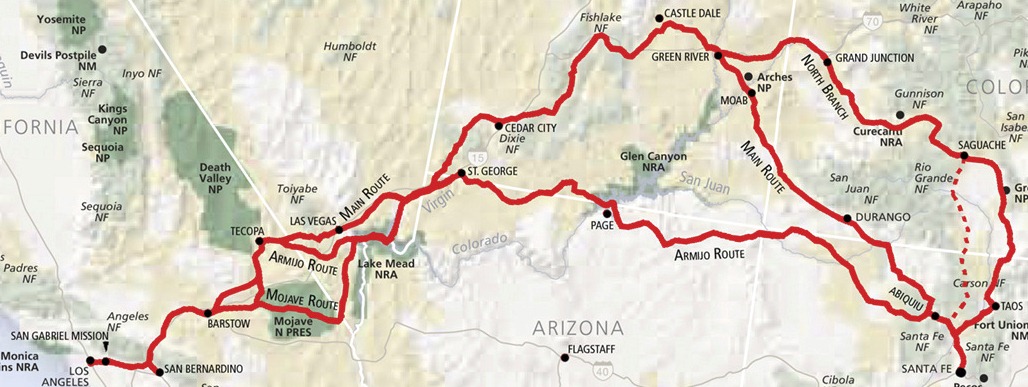
- November 7, 1829: Left Abiquiu New Mexico
- West down Largo Canyon
- November 15, 1829: San Juan River
- November 19, 1829: Left the main branch of the Old Spanish Trail
- November 21, 1829: Junction of the San Juan and Mancos Rivers
- November 25, 1829: Chinle Creek
- November 27, 1829: Church Rock
- November 29, 1829: Boiling Springs = Navajo National Monument
- November 30, 1829: Upper Crossing Spring = Paiute Canyon
- December 2, 1829: Junction of the Navajo and Kaibito Creeks
- December 6, 1829: Crossing of the Fathers = Colorado River
- December 9, 1829: Wahweap Creek, White [Blanco] Canyon
- December 10, 1829: Settlement of Payuches, Red Ridge [artenejál of Ceja Colorado]
- December 11, 1829: Creek of Ridge [Ceja] Canyon
- December 12, 1829: Crossed Cockcomb and the north end of Kaibab Mountain, Top of the tree-covered ridge
- December 13, 1829: Colorado Pueblo
- December 14, 1829: Reached Ram [Carnero] Creek = Kanab Creek
- December 15, 1829: At Water of the Old Woman [Agua de la Vieja] = Pipe Spring
- December 16, 1829: Coyoto Plains
- December 17, 1829: Limestone [Caloso] Canyon - Hurricane Cliffs
- December 18, 1829: Stopped: Reconnaissance party went out and returned with nothing to report
- December 19, 1829: Stinking Water Canyon
- December 20, 1829: Junction of the Pearce Wash and Severe [Severo] = Virgin River
- December 21, 1829: Stopped: Reconnaissance party went out
- December 22, 1829: Followed the Virgin River to the Cornfield [Milpas] = Santa Clara River; Reconnaissance party rendezvoused without mishap
- December 23, 1829: Headed up the Santa Clara River to Little Wild Squash [Calabacillas] Arroyo
- December 24, 1829: Below the Santa Clara River, Crossed over Utah Hill
- December 25, 1829: Hit the Virgin River again at Littlefield from where a reconnaissance party went out
- December 26, 1829: Down the Virgin River
- December 27, 1829: Indian settlement (natives had rings in their noses and were non-hostile
- December 28, 1829: Down the Virgin River
- December 29, 1829: At the slough of the Virgin River
- December 30, 1829: Along the Virgin River
- December 31, 1829: Along the Virgin River, the reconnaissance party rendezvoused (missing Rivera)
- January 1, 1830: Junction of the Virgin and Colorado [Rio Grande] Rivers
- January 2, 1830: Rugged trail along the Colorado River
- January 3, 1830: Rugged trail along the Colorado River
- January 4, 1830: Stopped: Reconnaissance party went in search of Rivera
- January 5, 1830: Stopped: Reconnaissance party returned without Rivera
- January 31, 1830: Arrived at the San Gabriel Mission
HISTORY
The party of 60 men and a pack string of 100 mules left Abiquiu New Mexico on November 7, 1829.Expedition members included:
Antonio Armijo
Salvador Maes
??? Rivera
???
They passed through Washington County during the later half of December 16 and 24, 1829.
They arrived at the San Gabriel Mission near Los Angeles on January 31, 1830.
Armijo and his men traded wool to the Californios for horses and mules.
The Armijo party left Los Angeles to return to New Mexico on March 1, 1830.
They arrived back at Abiquiu on April 25, 1830.
The horses a mules they acquired in California were sold for a substantional profit.
PHOTOS
TBDREFERENCES
Wikipedia article about Antonio ArmijoFrom the San Juan to the Virgin - Armijo's 1829 Journey along the 37th Parallel
by Steve Heath
Spanish Traces, Volume 10, Number 3, Fall 2004, pp. 16-19.
The Armijo journal was published in
Old Spanish Trail - Santa Fe to Los Angeles
by Leroy & Ann Hafen (1954)
pp. 155-170
Armijo's Trace Revisited: A new Interpretation of the Impact of
Antonio Armijo Route of 1829-1830 on the Development of the Old Spanish Trail
by Elizabeth von Till Warren
Master's Thesis, University of Nevada, Las Vegas
May 1974